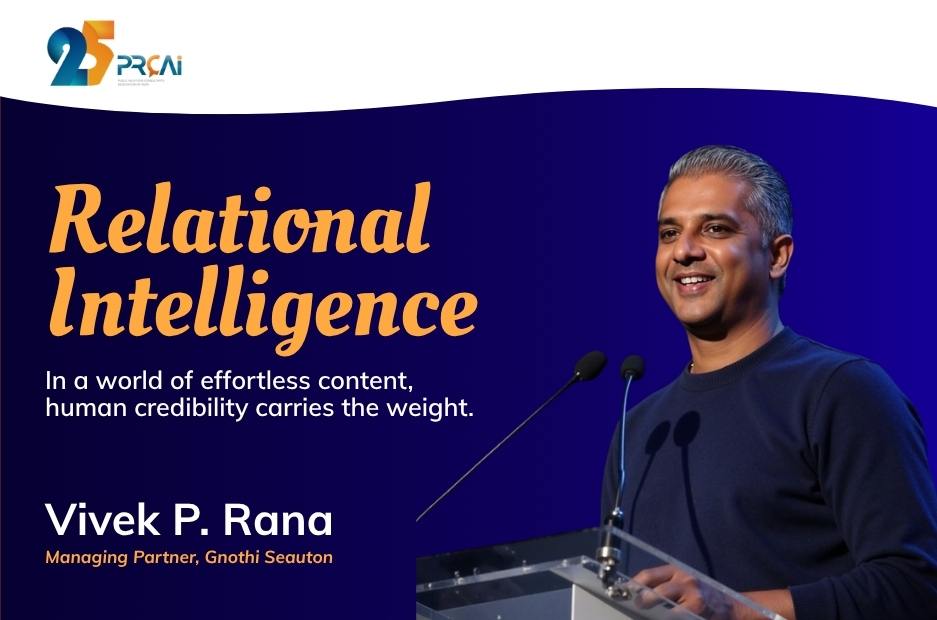
Relational intelligence is the new currency of communication
In a world of effortless content, human credibility carries the weight.
By Vivek P. Rana
Managing Partner, Gnothi Seauton
Content is now free. Not cheap, free. A competent article, a thoughtful post, even a crisis statement can be produced in seconds, polished and structured, yet increasingly forgettable. For years, organisations competed on output. More campaigns, more visibility, more noise. That worked when attention was scarce and production was hard. That constraint has disappeared. What remains is a different scarcity: belief. Stakeholders are no longer asking what you said. They are asking whether you meant it.

Look closely at most organisations today. They are communicating constantly, but they are not being heard. Employees receive updates but do not feel understood. Customers see messages but do not sense conviction. Investors read narratives but question alignment. This is not a content problem. It is a relationship problem, and more content will not fix it. In fact, it makes it worse.
The more effortless communication becomes, the more audiences look for signals that it required effort. Judgement. Specificity. Restraint. These are signals of human intent. This changes the role of communication entirely. It is no longer about what you say. It is about whether your words carry weight. That weight comes from history, from consistency, from the sense that there is a real point of view behind the language. Not a system generating it, but a leader standing behind it.
Most organisations are not built for this. They are optimised for speed, for response, for presence. But trust is not built in real time. It is accumulated slowly, often when no one is watching. So the question for CEOs is not whether you are communicating enough. It is simpler. If you stopped speaking tomorrow, would anything weaken, or has your communication already become something that can be replaced, replicated, or ignored?
In a world where language is abundant, relational intelligence is the only thing left that cannot be automated. And the only thing that still earns belief.